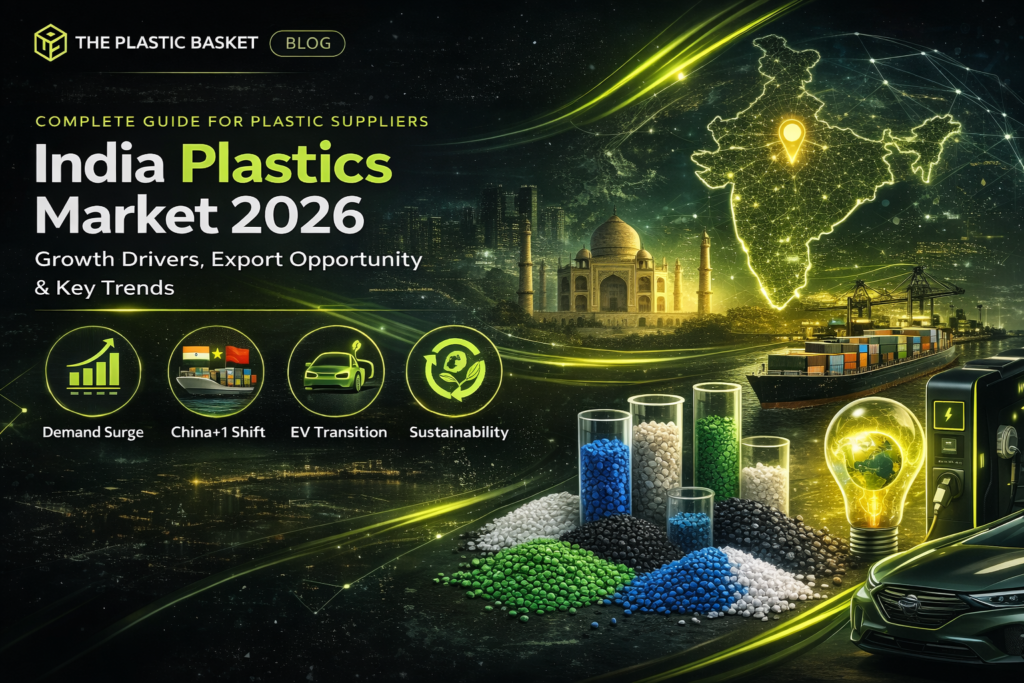
India’s plastic consumption reached approximately 22–24 million tonnes in 2024–25, making it the world’s third-largest plastic consumer behind China and the USA. But the per-capita comparison reveals the growth runway: India consumes approximately 16 kg of plastic per person per year, against a global average of 35 kg, China’s 75 kg, and the USA’s 120 kg. As Indian per-capita income rises and consumer goods penetration deepens in tier-2 and tier-3 cities, per-capita plastics consumption has significant headroom to grow — with structural tailwinds from urbanisation, the FMCG sector’s premiumisation wave, and infrastructure expansion.
| Growth Driver | Primary Plastic Segment | Growth Rate Estimate (2024–27) |
|---|---|---|
| Housing and construction (PMAY, Smart Cities) | uPVC pipes, CPVC, profiles, insulation | 8–12% |
| Automotive growth + EV transition | Engineering compounds, EV battery materials | 7–10% |
| Packaged food and FMCG premiumisation | Rigid PET, PP containers, flexible laminates | 8–10% |
| Water infrastructure (Jal Jeevan Mission) | HDPE PE100 pipe | 12–15% (government-driven) |
| Electronics manufacturing (PLI) | Engineering plastics, FR compounds | 10–15% |
| Pharma packaging expansion | PETG, PVC blister, HDPE | 9–12% |
The structural diversification of global supply chains away from China — accelerated by geopolitical tensions, COVID supply disruptions, and client risk management — is creating genuine and durable opportunity for Indian plastics exporters. India’s masterbatch sector is particularly well-positioned: globally competitive on cost, with established export relationships across ASEAN, the Middle East, and Africa, and growing traction in European and North American markets. Engineering compound exports are growing but face longer qualification cycles in automotive and electronics supply chains. The China+1 opportunity is real — but requires investment in quality certification (IATF 16949, REACH compliance), English-language technical service capability, and consistent on-time delivery performance.
India’s EV transition (2-wheelers leading, 4-wheelers following) is creating new material requirements while eliminating others. Under-hood thermal management compounds for high-temperature ICE applications face declining long-term demand. New requirements emerging: battery housing compounds (FR grades, thermally conductive polymers for EV thermal management); lightweight structural composites for EV body panels (range enhancement); and high-voltage electrical isolation materials (tracking resistance, creepage specifications). Indian compound manufacturers with investment in EV-specific grades are positioned for above-market growth as Indian EV production scales.
India’s EPR framework, SUP bans, and recycled content mandates create compliance cost — but also create new business opportunities. Companies building recycling infrastructure, rPET/rHDPE supply chains, and biodegradable alternative capacity are positioning for the regulatory tailwind toward 2030 targets. The biggest risk: doing nothing and being caught on the wrong side of accelerating enforcement. See our EPR and sustainability guide for the current regulatory obligations.
The EU-India Free Trade Agreement (under active negotiation as of early 2026) could be transformational for Indian plastics exporters. Current EU MFN import duties on plastics range from 4.2% to 6.5% for raw material forms and higher for finished articles. An FTA reducing or eliminating these duties would open significant European market opportunities for Indian masterbatch (highly cost-competitive) and engineering compounds. For our detailed analysis, see the EU-India trade deal and plastics industry.
Find Verified Suppliers
18,000+ verified listings. RFQ to quote in 4 hours. Free for buyers.
Browse Listings →© 2025 -The Plastic Basket